Our first presentation showcased our initial idea of a service we believed could benefit the library experience. We introduced two new touchpoints to the service that we felt addressed many of the problems highlighted by our research:
- Limited staff
- Low seating capacity
- High noise levels
- Under-usage of facilities at key times
- Lack of awareness of library services
- Limited opening hours
The first touchpoint was an app that linked users to their local library network, allowing them to plan and manage their next library visit. The app put local library resources at users’ fingertips, allowing them to book study time, view upcoming events, and to find and choose a library that best suited their particular needs.
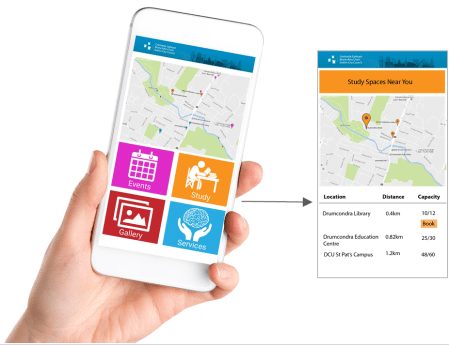
The app would have the effect of helping to efficiently utilize the limited seating capacity, help to reduce noise-related frustrations of people who wanted to study/read in silence, and allow users to plan and view events on the go. We saw the combination of all of these features in an app as a way to give added responsibility to the community members with regard to their library, thus freeing up valuable time for the librarian to continue making the library a local social hub for the community.
The second touchpoint suggested was a kiosk that would be placed inside the library. It served a dual purpose: to act as a digital notice board and to allow quick and easy check in/out of people who booked study space. Users could view and suggest upcoming events, view and create services among members, and leave comments, questions, and suggestions for the betterment of the library and the local community at large.
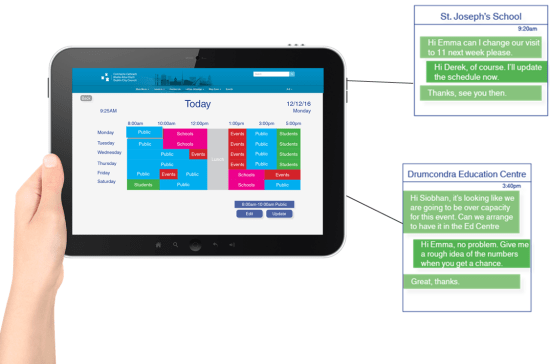
The combination of these two services would be complimented by a Librarian PA that collated data inputted by users. The librarian could see who was booked in for study and when, and could interact with the comments and messages that users would leave on the app or at the kiosk, helping to organize events or offer advice.
The presentation went on to show how two different users might use the new touchpoints and service as a whole to make their library experience more suitable for their needs. Sean, a busy student looking to study, could easily find and book a study time when it’s suitable quiet to do so. Declan, a required teacher looking to give back to the local community, could advertise his availability to give classes in his area of expertise.
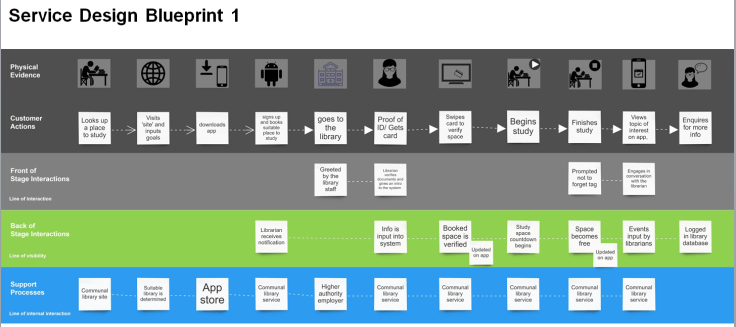
After feedback from our lecturers, Louise and Marcus, it became apparent that we had overreached with our service design suggestions. Unlike our previous projects where we were given leeway to let our imaginations run riot regardless of cost, technical possibilities, or practicality this service design project should be more based in the reality of the situation. The practicalities involved in creating the suggested app, getting by-in from all of the local libraries, and establishing all the related infrastructure, made the suggestions realistically unfeasible. The same could be said for the kiosk and the expense of implementing these two systems, especially in a time when libraries are already struggling to stay afloat.
Although I feel we accurately identified the real problems faced by the library, perhaps we tried too hard to solve them all simultaneously, an unrealistic task unless the library in question had very deep pockets.
Our team took the Christmas holidays as an opportunity to rethink our approach and to start afresh when we returned.


Leave a Reply