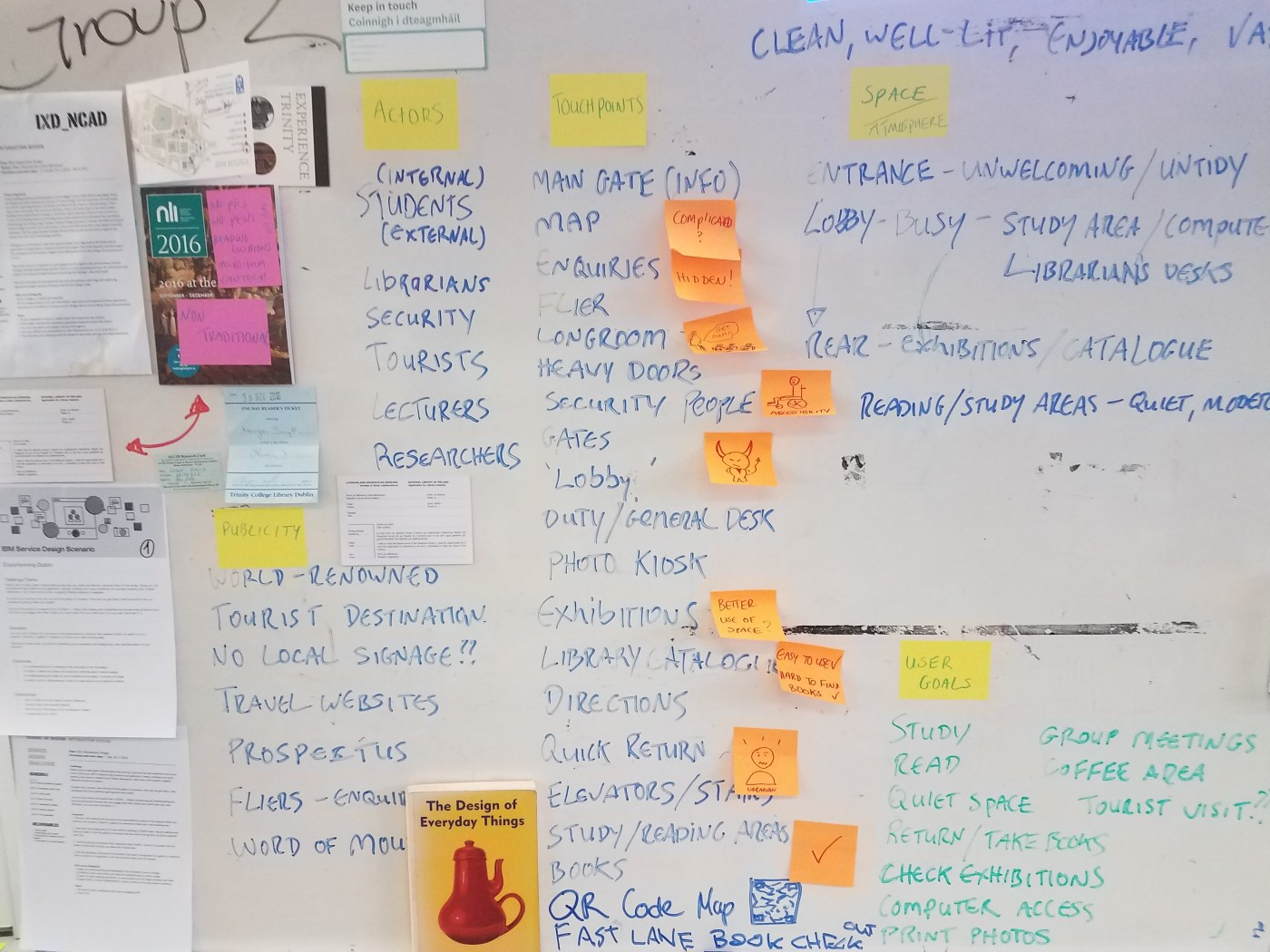
The class were divided up into teams based on proximity to a list of appropriate libraries and then each team headed off on a library service safari tasked with analyzing one based on the following criteria.
- Services
- Facilities
- Space/Environment
- Future
- Community
- Users
- Emotions/Empathy
- Function/System
- Stakeholders
Our team’s first port of call was to stop into the NCAD library as a comparison for our main goal, Trinity College Library. Making notes on the categories in the list above, we played the role of what we considered the standard user, finding and checking out a book as well as requesting a card to enable us to enter Trinity College library.
Our next step was to make our way to Trinity on foot, considering waypoints and general accessibility. Once there, we considered the library in the same terms as we used at NCAD. We also interviewed a librarian and found some interesting pain points around the quick-return facility. We made note of any opportunities to improve the services as well as things we thought worked well.
Following our trip to Trinity, we walked over to the National Library to attempt to do the same kind of analysis. However, as a non-traditional library, our activities were somewhat curtailed by the fact that we weren’t allowed wander around taking notes, as well as an inability to take pictures.
The following day, our 3 team members arranged our findings on a white board using post-it notes, markers and blu-tac to stick up any physical artifacts we picked up along the way.
For me, the service safari was hard to get my head around at first. Because of the sheer volume of things that could be considered touchpoints or waypoints, especially around some of the larger libraries, I constantly found myself wondering if I was overlooking anything that might later turn out to be important. This could well have been the case but given the relatively limited time we had to go through the process I think we did pretty well in amassing the quantity of data that we did. It also dawned on me that in a real-world service safari, we’d probably have a lot more time to observe, interview, probe etc.


Leave a Reply